Choosing the right wood for your coffee table can transform your space. Discover essential tips and styles to find the perfect fit for your home.
The wood behind a coffee table decides more than day-one looks. It decides how the piece survives five years of coffee mugs, kids’ toy cars, humidity, and the next time you rearrange the living room. Whether you’re furnishing one home or specifying furniture for a 200-unit residential development, the same question comes up: which wood actually holds up, and which one just looks like it will?
This guide breaks the answer into three tiers, budget-friendly softwoods, dependable hardwoods for everyday homes, and premium exotic species for standout pieces, so you can match the wood to the room, not the other way around.
Why the Wood You Choose Changes Everything
Every wood species trades off four things differently: durability, appearance, maintenance, and price. A wood that resists scratches might not take a dark stain well. A wood that looks striking in a showroom might dent the first time a set of keys lands on it. None of that is a flaw it just means the “right” wood depends on how the table will actually be used, not which one looks best in a photo.
Tier 01 — Budget-Friendly: Softwoods for Casual Spaces
Softwoods come from coniferous trees and grow faster than hardwoods, which keeps the cost down. They’re softer literally so they dent and scratch more easily, but for casual spaces or budget-conscious projects, that trade-off is often worth it.
Pine — Affordable and Easy to Customize
Pine is one of the most affordable coffee table woods available. It’s visible knots give it a rustic character, and it takes stain well, so the same piece of pine can look farmhouse-rustic or lightly Scandinavian depending on the finish. It shows dents faster than a hardwood, so it suits low-to-medium traffic spaces best.
Cedar — Natural Aroma and Pest Resistance
Cedar resists decay and insects naturally, without chemical treatment. It has a warm, reddish tone and a distinct aroma when freshly finished. Like pine, it’s softer than hardwood, so it’s a better fit for a casual living room than a high-traffic family room.
Tier 02 — Everyday Durable: Hardwoods for Busy Homes
Hardwoods come from slow-growing deciduous trees, which is why they’re denser and more resistant to daily wear. If durability is the priority a living room with kids, pets, or heavy foot traffic this category is the safest starting point.
Oak — Built for High-Traffic Living Rooms
Oak’s grain is bold and visible, which is part of why it reads as “classic” or “traditional” in most rooms. It resists dents and scratches well, making it a practical pick for busy households. Because oak takes stain evenly, it also works in darker, more contemporary finishes if the natural blonde tone isn’t the look you want.
Maple — Clean Lines for Modern Interiors
Maple’s grain is much finer and more even than oak’s, giving it a smoother, quieter appearance. It resists warping better than most hardwoods, which is useful in humid climates. If your space leans modern or minimalist, maple’s pale, understated color works with almost any palette.
Walnut — Rich Color for a Premium Look
Walnut’s deep brown tone and fine grain give it a naturally premium look without a heavy finish. It’s slightly softer than oak but still durable enough for daily use. Walnut tends to be priced above oak and maple, but for a piece meant to anchor the room, it’s often the wood people notice first.
Tier 03 — Statement & Premium: Exotic Hardwoods
These species cost more sometimes significantly more but they bring durability, rarity, or both. They tend to show up in premium residential projects and hospitality lobbies where the coffee table is meant to be a focal point, not just a surface.
Teak — Moisture Resistant, Indoor or Outdoor
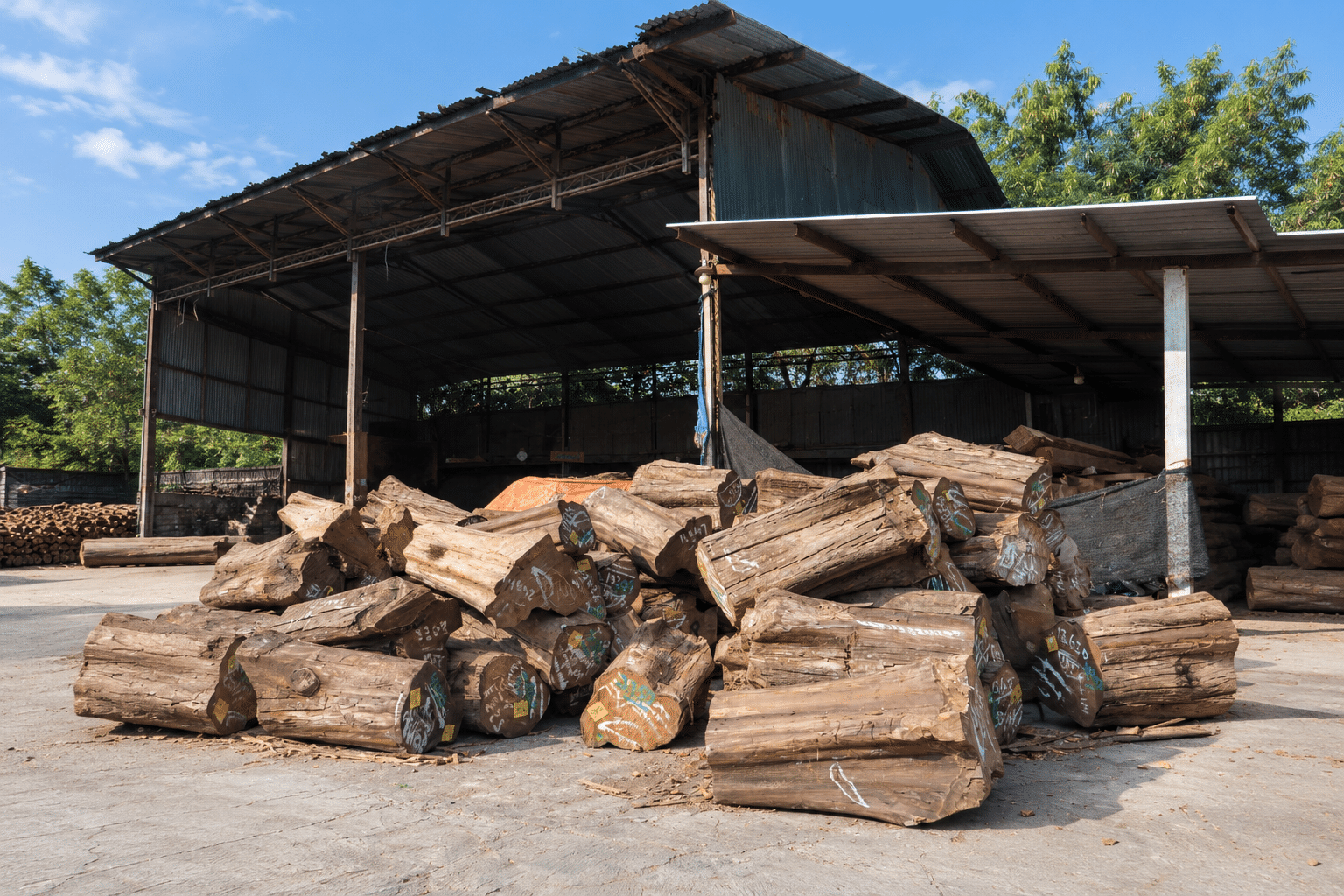
Teak’s natural oils make it one of the few woods that genuinely performs outdoors as well as indoors, resisting moisture and decay without a protective finish. That versatility, plus its golden-brown color, is why it shows up constantly in hospitality and resort furniture across Southeast Asia.
Mahogany — Deep Color, Timeless Elegance
Mahogany’s reddish-brown tone and fine, straight grain read as timeless rather than trendy, which is part of why it’s stayed popular for generations. It’s a stable wood less prone to warping but it does need occasional polishing to keep its color from dulling.
Rosewood — Bold Grain for a One-of-a-Kind Table
Rosewood’s grain patterns are dramatic and highly individual no two pieces look quite the same. That uniqueness comes at a price, and rosewood needs protection from direct sunlight to prevent fading, but for a single statement piece, it’s hard to match.
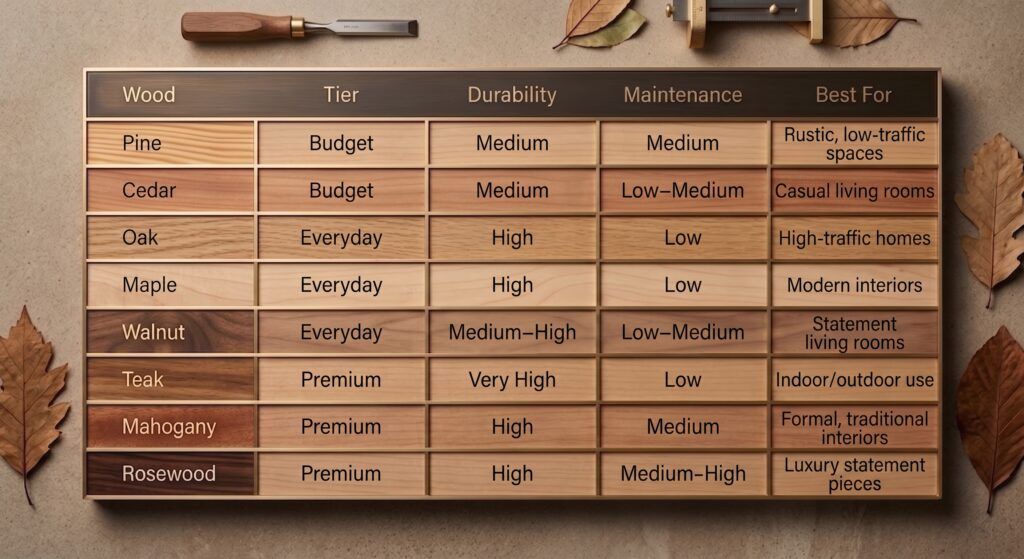
Durability and Maintenance at a Glance
Finishes: How Matte, Glossy, and Stain Change the Look
The finish changes a table’s personality as much as the wood itself does. Matte finishes keep the wood’s natural texture visible and work well with oak and pine, where the grain is the main feature. Glossy finishes add shine and a layer of surface protection a natural fit for maple and walnut, where a smoother, more polished look suits the wood.
Stains can shift a wood’s color entirely: a dark stain turns oak or mahogany dramatic and formal, while a light stain keeps pine or cedar casual. Paint is the most flexible option but hides the grain completely, which is worth considering before committing.
What This Means for Your Budget
Price generally follows the tiers above: softwoods are the most affordable and the most forgiving for DIY projects; hardwoods sit in the middle, with walnut usually priced above oak and maple; exotic species carry the highest price, reflecting slower growth, rarity, or import costs. Exact pricing varies by region, supplier, and order volume treat this as a relative guide, not a fixed budget.
Sustainable Wood Options for Eco-Conscious Homes and Projects
Sustainability in furniture starts with where the wood comes from, not just which species it is. FSC (Forest Stewardship Council) certification confirms wood was harvested from a responsibly managed forest look for this on oak, walnut, and teak in particular, since certified supply is increasingly available for all three.
Reclaimed wood, salvaged from old buildings and structures, brings character along with a lower environmental footprint. Bamboo, technically a grass rather than a tree, grows fast enough to be one of the more renewable options on the market, with a hardness that holds up reasonably well in furniture.
For buyers furnishing at scale, traceable, certified sourcing is becoming less of a nice-to-have and more of a baseline expectation it’s part of why Asean Sourcing’s manufacturer network is built around certified wood supply rather than treating it as an add-on.
Matching Wood to Your Home’s Style
Traditional & Rustic — Oak and pine, with their visible grain and warm tones, suit traditional and rustic interiors well especially paired with leather furniture and natural textures.
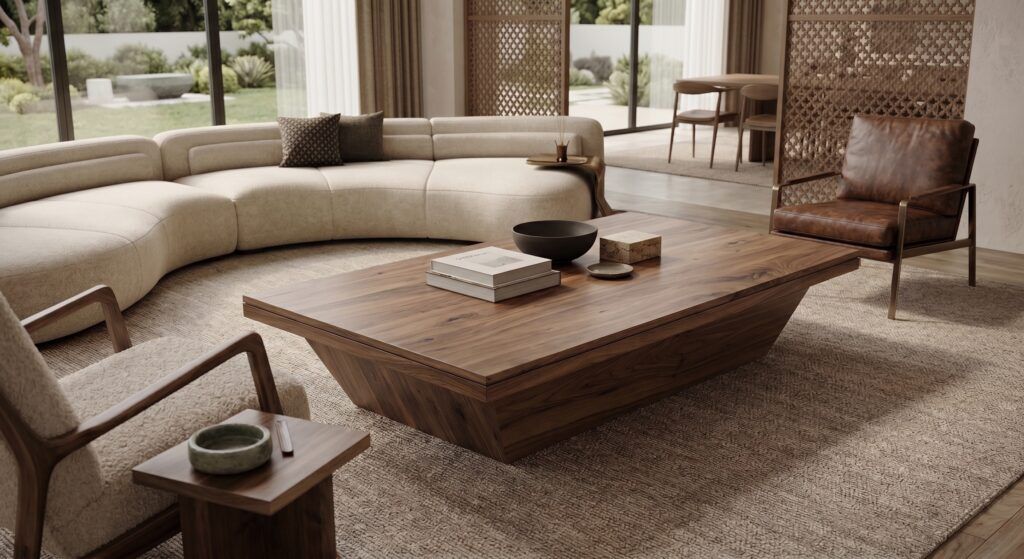
Modern & Minimalist — Maple and walnut’s cleaner lines fit modern spaces. A glossy maple table against neutral furniture reads as sophisticated without trying hard; walnut adds warmth to an otherwise cool, minimal palette.
Eclectic & Bohemian — Reclaimed wood or mixed finishes suit eclectic spaces, where the goal isn’t uniformity it’s a considered mix that still feels intentional rather than random.
DIY Build vs. Working With a Trusted Supplier
For a single coffee table, building it yourself is a reasonable option if you have the tools and patience pine, in particular, is forgiving for a first woodworking project. The trade-off is time, and the cost of materials and tools can add up faster than expected for a one-off piece.
For residential projects at scale multiple units, a portfolio of properties, or a full interior design rollout DIY isn’t really the comparison. The real question is consistency: can every table in every unit match the same grain, finish, and quality standard, delivered on the same timeline? That’s where working with an established supplier matters more than the wood choice itself. Asean Sourcing manages sourcing, quality control, and delivery for residential and hospitality furniture under a single contract, so procurement teams aren’t juggling multiple factories or comparing one unit’s walnut tone against another’s.
Frequently Asked Questions
What is the most durable wood for a coffee table?
Teak is the most consistently durable option, especially for pieces exposed to humidity or occasional outdoor use, thanks to its natural oils. Among hardwoods, oak resists daily dents and scratches better than most.
Is teak or oak better for a coffee table?
It depends on the setting. Teak handles moisture and outdoor conditions better and needs less long-term maintenance. Oak is typically more affordable and gives a more traditional look for indoor-only use.
What is the difference between hardwood and softwood furniture?
Hardwood comes from slow-growing deciduous trees oak, maple, walnut and is denser and more wear-resistant. Softwood comes from faster-growing coniferous trees pine, cedar and is more affordable but softer, so it shows dents and scratches more easily.
What is the difference between solid wood and wood veneer?
Solid wood is the same species all the way through, so it can be sanded and refinished multiple times over its life. Veneer is a thin layer of real wood over an engineered core it costs less and resists warping, but it can only be refinished once or twice before the base layer shows through.
How do I choose sustainable or FSC-certified wood furniture?
Look for FSC certification on the product or ask the supplier directly it confirms the wood was harvested from a responsibly managed forest. Reclaimed wood and bamboo are worth considering if certified virgin timber isn’t available in the species you want.
Finding the Right Wood — At Any Scale
The best wood for a coffee table isn’t the one with the nicest showroom photo it’s the one that matches how the room actually gets used, how much maintenance you’re willing to do, and what the budget allows. Oak and maple cover most everyday homes well. Pine and cedar work for casual, budget-conscious spaces. Teak, mahogany, and rosewood earn their price in high-end or high-exposure settings.
If you’re furnishing a single room, that decision stops here. If you’re specifying furniture for a residential development, a portfolio of units, or a hospitality project, the harder question is finding a supplier who can deliver that same wood, consistently, across every piece.
A residential project at scale shouldn’t mean coordinating brokers, subcontractors, and inconsistent quality control. As a principal supplier not a broker Asean Sourcing manages furniture and home decor procurement, quality, and delivery under one contract, across Asia
Related posts
Furniture for Coastal Hotels & Resorts: How to Specify for Salt, Sun and Humidity
A beachfront property tests furniture in ways an inland hotel never will. Salt in the air, hours of d …
Behind Every Delivery: How We Vet the Furniture Factories You Never See
You see the finished room. Here’s everything that happened before it got there. How do you vet …