By Asean Sourcing | FF&E and OS&E sourcing for hospitality and residential projects
A city restaurant can refit one section at a time and keep serving. A beach club or seasonal coastal restaurant usually can’t. You get one window between your last service of one season and your first guest of the next, and the furniture has to land inside it.
That sounds like a scheduling detail. It isn’t. For a coastal venue, the furniture sourcing timeline decides whether you open with a full terrace, open with half of it, or open late in the weeks that earn the most.
This guide counts backward from opening day, so you can see when each sourcing decision has to be made. It also covers what to do when the dates don’t fit.
Why a beach club or coastal restaurant runs on a different calendar
A city restaurant can absorb a late delivery. It closes one section, or a few days, and keeps trading. A late shipment moves one area, not the whole venue.
A seasonal beach club or coastal restaurant has a fixed window and a hard opening date, and the terrace or deck is usually what guests come for. Three things make that calendar less forgiving:
- The window is short and fixed. Contractors, installers and delivery slots are all booked around the same few weeks.
- Shipping has a long tail. Sea freight, port clearance and inland delivery all sit between the factory and the lobby, and each can slip.
- The coast sets the specification. Salt, sun and humidity belong in the spec before sampling starts, because changes after design freeze eat into the window. Our coastal furniture specification guide shows what to write down.
Start at opening day and count backward
Many renovation schedules are planned forward: we need furniture, so let’s find it. A fixed window needs the opposite. Start from the date the first guest arrives, then give every step before it a duration. The durations add up to a start date that is earlier than many owners expect.
For a typical custom or semi-custom order for a beach club or restaurant, made in Asia and shipped to the Mediterranean, a working model looks like this:
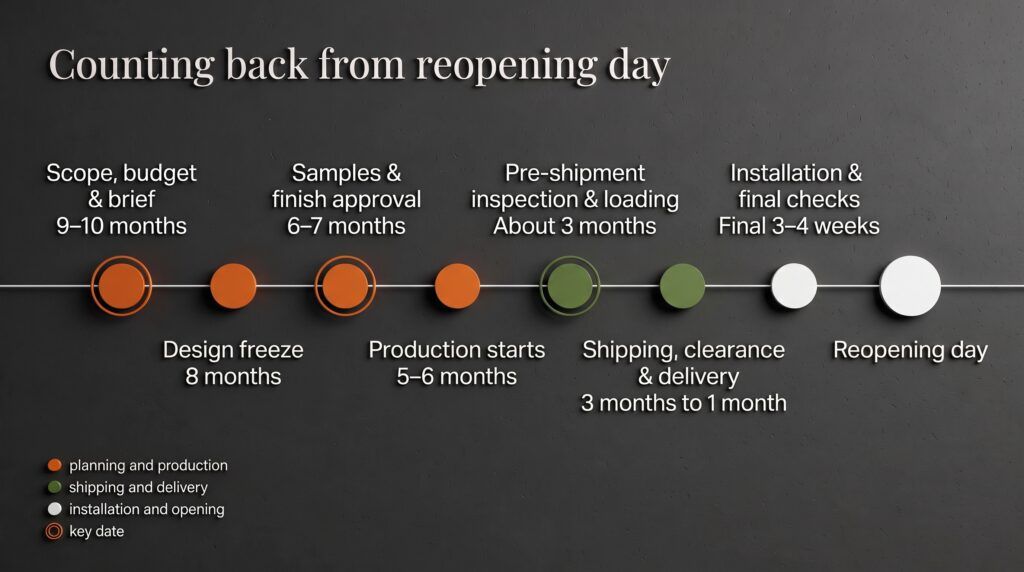
Of these seven milestones, three carry the most weight: the brief (9–10 months out), sample sign-off (6–7 months out) and loading day (about 3 months out). Read the table from the bottom up. For a spring opening, scope and design freeze fall in the middle of the previous season, while you are still serving guests. Sourcing for next season starts before this season ends. If you take one thing from this article, take that.
These are planning ranges, not promises. Scope, finishes, quantities and shipping routes all move them, which is why we build the real timeline with each project, starting from your date.
When the dates don’t fit: phase the delivery
Sometimes the brief arrives late, the design freeze slips, or the window turns out shorter than planned. The fallback is phased delivery: split the order into stages and land the revenue-critical pieces first.
A practical split:
- Phase 1, in before opening: dining tables and chairs, bar seating and your main lounge area. For a beach club, add sunbeds and daybeds here.
- Phase 2, in for opening or a soft opening: secondary seating areas and terrace extensions, depending on how you trade.
- Phase 3, follows after opening: décor, accessories and OS&E top-ups such as tableware and serveware.
Phasing only works when it is planned from the start. Split shipments need matching finishes and fabrics across batches, and one schedule that every phase answers to. Three orders from three suppliers rarely manage that. One contract with one schedule does.
Three planning mistakes that cost the window
- Waiting for the season to end before sourcing begins. By then the timeline is already behind.
- Freezing the design without a coastal specification. Extra sampling rounds to fix finish or fixing problems are an easy way to lose weeks.
- Counting delivery as the finish line. Installation and final checks need their own weeks, and shipping needs a buffer. Both belong in the plan before the order is placed.
The same count works for a new venue
Opening a brand-new beach club or restaurant? You still have a fixed date: a lease start, a launch event, the first booked weekend. The furniture package is often the last thing to arrive and the first thing guests see. Replace “opening day” with your launch date and the table above still holds.
How Asean Sourcing builds the timeline with you
We are a principal supplier, not a broker. That means one contract, one schedule and one point of accountability from the first sample to the last delivery.
For a beach club or restaurant renovation, we start from your opening date and map each stage: custom product development and sample approval, production through our manufacturing network across Indonesia, Vietnam, Malaysia and China, quality checks during production and before shipment, export documentation, and shipping to your site. If the window is tight, we help you decide what has to land first and what can follow.
Frequently asked questions
How early should a beach club or restaurant start sourcing furniture for a renovation? For custom or semi-custom orders, plan to start roughly nine to ten months before opening. Catalogue pieces move faster, but an order is only as fast as its slowest item.
How long does furniture take to ship from Asia to the Mediterranean? Sea transit alone is measured in weeks, and clearance and inland delivery add more. Plan around two months from loading to site, add a buffer, and confirm the route for your specific shipment.
Can restaurant or beach club furniture be delivered in phases? Yes, if it is planned from the start. Phasing needs matching finishes across batches and a single schedule.
Plan your renovation window
Tell us your opening date and the scope of the project. We’ll count backward and show you the date your furniture order has to be placed.
Book a renovation timeline consultation
Related posts
Furniture for Coastal Hotels & Resorts: How to Specify for Salt, Sun and Humidity
A beachfront property tests furniture in ways an inland hotel never will. Salt in the air, hours of d …
Behind Every Delivery: How We Vet the Furniture Factories You Never See
You see the finished room. Here’s everything that happened before it got there. How do you vet …